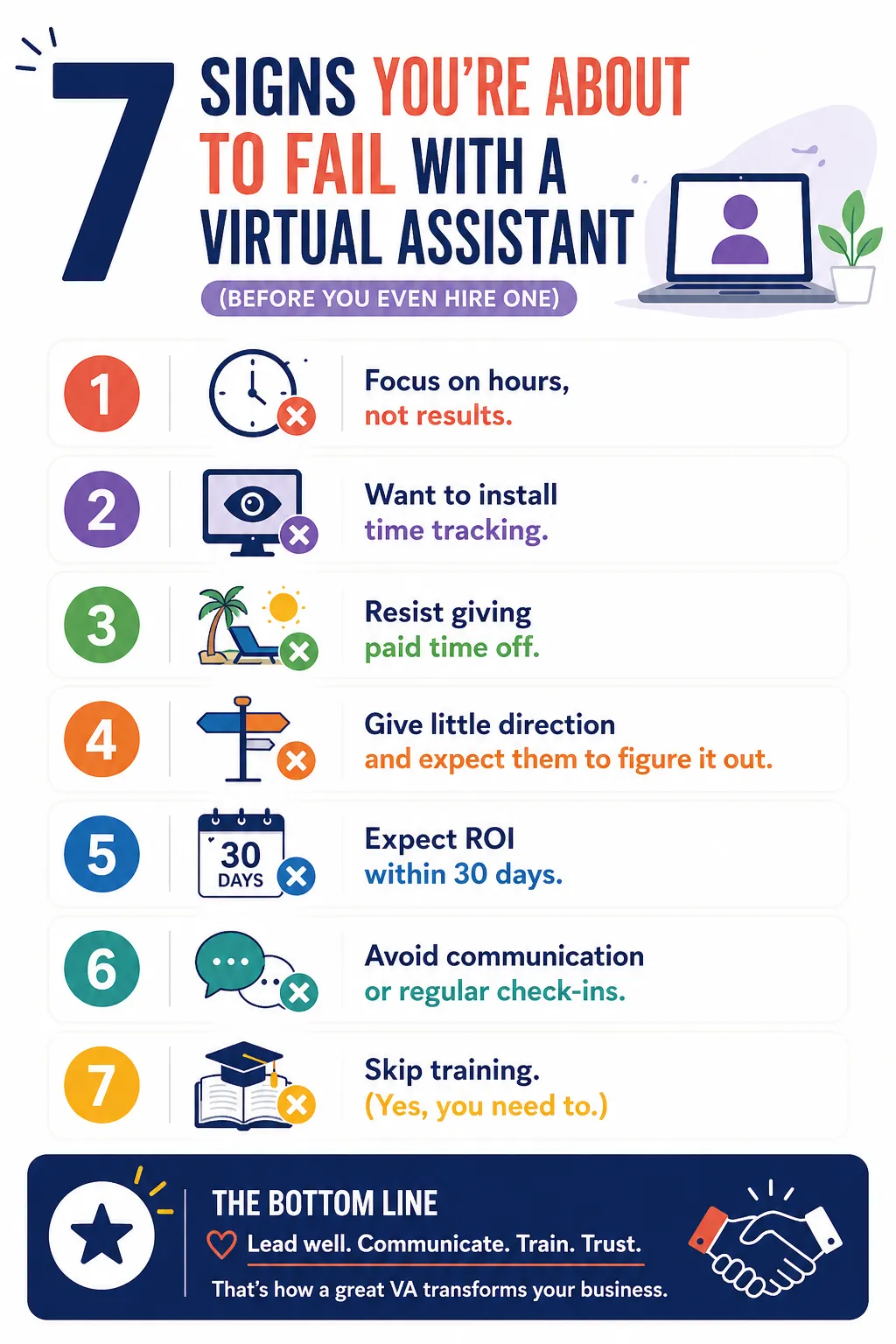
7 Signs You're About to Fail With a Virtual Assistant (Before You Even Hire One)
I had a client once, we’ll call him Fred, who was a very interesting character. He was gruff, always bitter and cynical, direct, a bit of a bully. When he signed up with us and we arranged his interviews with potential VA candidates we didn’t know that he liked to use what he called “hostile interview” tactics.
Basically what that meant was, he would come into the interview with an attitude and list of questions designed to make the candidate feel as uncomfortable as possible to see if they could handle the pressure. He thought this was a clever way to screen applicants to see if they had what it took to be successful in his organization. Interestingly enough, Fred was having problems with turnover, which is why he came to us.
Anyway. He had three candidates lined up and blindsided us in the first one with that little stunt. We cut the interview short and after the VA logged off the Zoom call I lit into him with a series of questions along the lines of “what the hell was that you lunatic?”
Fred gave his explanation, which I rejected in no uncertain terms, and told him if he did that again with the next two candidates we would promptly fire him as a client.
Fortunately he behaved himself and ended up hiring a really sweet and talented girl to handle his social media and she ended up staying with him for two years before he died of cancer. His body literally ate itself up from the inside out. I don’t think that was a coincidence. He died the way he lived. Angry and bitter.
The Lesson for You
Hiring a virtual assistant is one of the smartest moves a small business owner can make - when you do it right. But after placing hundreds of VAs with business owners across the US, we've noticed some patterns. Specifically, some very predictable ways clients set themselves up for failure before their VA's first day even starts.
If you've asked any of the following questions - or caught yourself thinking them - this article is for you. Not to shame you, but to save you.
1. "How do I know my VA is putting in the hours they say they are?"
Let's start with the most common one. If your first instinct is to monitor hours, you've already lost the plot.
Hours are a proxy metric. What you actually (or should) care about is: Is the work getting done? Is it getting done well? Is it getting done on time?
A VA who works 8 hours but produces nothing is worse than a VA who wraps up in 5 hours and nails everything on their list. Obsessing over time-tracking is a holdover from traditional employment thinking - and it poisons the working relationship before it begins.
Shift your focus to outputs and deliverables. Set clear expectations for what "done" looks like and set a realistic deadline for it. That's how you build a productive, trust-based working relationship.
2. "Can I install a time tracker on their computer?"
This one's a cousin to the above, and it deserves its own section because of how much damage it does.
Asking to install tracking software on a VA's personal computer - one they likely use for multiple clients - is a red flag from the VA's perspective. It signals distrust immediately and makes it very hard to attract quality talent. The best VAs have options. They'll choose clients who treat them like professionals and aren't micromanaging them every minute of every day.
If you feel like you need to surveil someone to trust them, the real issue isn't the VA - it's the absence of a clear system for setting expectations and measuring results. Fix that instead.
As a side note, I’ve always said that if clients held themselves to the same time management standards that they hold their employees to their business would double in 6 months or less.
3. "How much paid time off do I have to give them?"
This question reveals a mindset that will make you a difficult client to work for. And difficult clients? They don't keep great VAs.
Virtual assistants - especially those placed through a structured program like Katuva's Empower+ program - are professionals. They have lives, families, and lives outside of work. When business owners bristle at the idea of PTO, what they're really signaling is that they view the VA as a tool, not a person.
Guess what happens when VAs feel that way? They do the bare minimum, they disengage, and they move on to clients who actually value them.
4. "I like to give my employees very little direction to see if they can figure things out on their own."
I am genuinely surprised by how often I hear this from people. This is usually framed as a leadership philosophy. In practice, it's a test that almost no new hire can pass - and it's completely unfair.
"Figure it out on your own" works for experienced team members who already understand your business, your systems, your preferences, and your standards. A brand new VA has none of that context. You're essentially setting them up to fail and then blaming them for failing.
Great delegation is clear delegation. Tell them what you need, why it matters, what success looks like, and what resources they have. That's not micromanaging - that's leadership.
5. "I need to see an ROI within 30 days."
We get it - you're running a business, not a charity. ROI matters. But 30 days? That's not a timeline, that's a trap.
A few things to consider here:
a) 30 days is too short. Most VAs spend the first few weeks just learning your workflows, tools, and preferences. You wouldn't expect a new employee to be at full capacity in their first month. The same applies here.
b) ROI isn't the only metric that matters. Have you heard of ROT - Return on Time? It's arguably more important than ROI, especially early on. When your VA takes tasks off your plate, you get time back. That time has value. Use it to close deals, build strategy, or just not burn out. That's ROT in action, and it often shows up long before a clear dollar return does.
c) ROI is mostly your responsibility. If your VA isn't generating a return, the first question isn't "what's wrong with them?" - it's "am I giving them tasks that actually move the needle?" A VA who's managing your inbox isn't going to generate direct revenue. A VA who's nurturing your leads, following up with clients, or running your content pipeline just might. But that VA managing your inbox? They are generating ROT…don’t discount the value in that.
6. "Do I really need to have team meetings or talk to them regularly? I'm too busy for that."
Imagine saying this about an employee you hired to come in to work in your office everyday. Sounds absurd doesn’t it?
Here's the hard truth: if you're too busy to communicate with your VA, you're too busy to have a VA.
That might sound harsh, but think about it. VAs need direction, feedback, and context to do their jobs well. Without regular touchpoints - even just a quick async check-in - they operate in a vacuum. They make assumptions. Work gets done wrong. Then you get frustrated. Then they get frustrated. Then everyone quits.
I had a client once call us up, frustrated that some work her VA turned in wasn’t up to her liking. Additionally, she pointed out that it took her VA two weeks to produce it. When I asked her when was the last time she talked to the VA she told me it had been about two and half weeks. That was mind-boggling to me. Were that my project I would have been on a Zoom after 2-3 days asking to see progress. We would have nipped that little issue in the bud right away instead of two weeks later.
To be clear, you don't need to be on a call every day. But some form of consistent communication is non-negotiable. Even 15–30 minutes every few days goes a long way toward keeping things aligned and building a working relationship that actually works.
7. "Do I need to train them?"
Yes. Full stop. This reminds me of the story of a conversation between a CEO and his CFO. The CFO asked the CEO, “What if we train our employees and they leave us?” to which the CEO replied, “What if we don’t and they stay?”
Even the most experienced VA on the planet doesn't know your business. They don't know how you like emails written, what your brand voice sounds like, which clients are VIPs, or how you organize your folders. That knowledge lives in your head - and it's your job to transfer it.
Training doesn't mean hand-holding forever. It means investing time upfront so you don't have to redo everything later. Think of it as building an asset: every hour you spend training now saves you multiple hours of corrections, confusion, and rework down the road.
The best client/VA relationships we've seen at Katuva all have one thing in common: the client showed up as a leader. They set clear expectations, they communicated, they trained, they gave constructive feedback - and then they let go and trusted.
The Bottom Line
Hiring a VA isn't a magic fix. It's a partnership. And like any partnership, it requires some investment from both sides.
If you found yourself nodding (or wincing) at any of these, don't worry - awareness is step one. The good news is every single one of these mindsets is fixable. And when you go in with the right expectations, a great VA can genuinely transform how you run your business.
Thinking about hiring your first VA or trying again after a rough experience? Book a free discovery call with us and let's make sure you're set up to succeed this time.


