Stop Choosing Between AI and Virtual Assistants (You Need Both)
I keep having the same conversation with clients, and it goes something like this:
"I think my virtual assistant is using AI to write content."
My response? "I hope they are."
That usually catches people off guard. But here's the thing—AI was designed to make us more productive, not to work in isolation. The real question isn't whether to use AI or humans. It's how to use them together.
The Critical Thinking Gap
AI can crank out content faster than any human. It can process massive amounts of data in seconds. It can create designs, infographics, and explainer videos that would take a person hours or days.
But here's what it can't do: think critically about context.
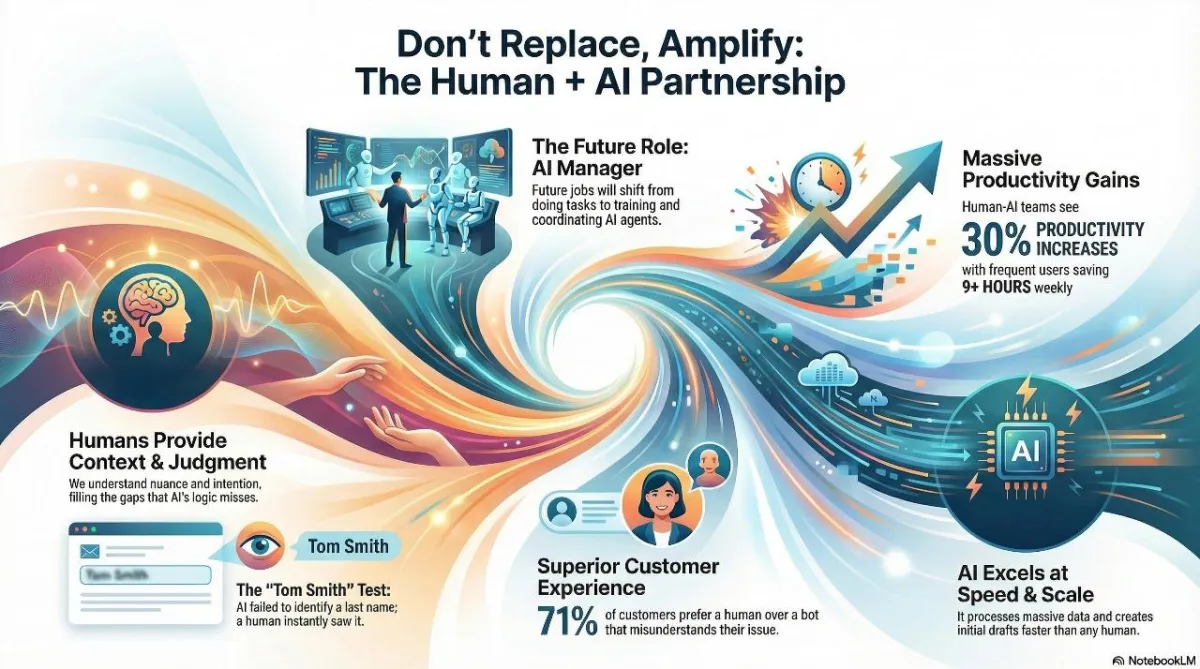
I watched this play out recently with a lead sorting system. The AI was filling in contact information as leads came through—name, email, phone number. Simple stuff.
Except when someone named Tom entered just his first name and left the last name field blank. His email? [email protected].
The AI left the last name field empty. It followed the rules perfectly. There was no data in the last name field, so it didn't populate anything.
A virtual assistant looked at that same record and immediately saw what the AI missed. The last name was right there in the email address. She manually added "Smith" to complete the record.
That's the difference. AI follows instructions. Humans understand intention.
Training AI Is Where Most People Fail
When I talk about using AI properly, people assume I mean typing a prompt into ChatGPT and hitting enter.
That's not training. That's hoping.
Here's what actual training looks like: You feed the AI examples of your past work. Your writing style. Your voice. Audio recordings. Videos. Anything that shows how you communicate.
Then you ask it to create content based on that foundation.
Most people skip this step entirely. They use AI out of the box and wonder why it sounds generic. Or too polished. Or just... off.
The telltale signs are everywhere. Overuse of emojis. Em dashes in every other sentence. Content that reads like it went through three rounds of corporate editing.
Real humans make mistakes. We say "uh" and "um." We use sentence fragments. We break grammatical rules for emphasis.
AI doesn't do that naturally. You have to train it to sound human, and even then, you need a human to polish the final product.
Where to Draw the Line
So when should you lean on AI versus humans?
My rule of thumb: Human-to-human interactions need humans.
Think about the last time you called customer support. You probably started with an automated system. Maybe it worked fine for simple stuff—checking your balance, getting store hours.
But the moment something went wrong? You wanted a human. Someone who could actually solve your problem, not just follow a script.
Research backs this up. Roughly 49% of people prefer interacting with a real person for customer support. Only 12% prefer chatbots. And 71% of customers would rather talk to a human agent than deal with a bot that doesn't understand their issue.
The airport kiosk is the perfect example. It works great until it doesn't. Then you need someone with critical thinking skills who can actually help you.
That's where you draw the line.
The Productivity Multiplier Nobody Talks About
When clients finally embrace the VA-plus-AI combination, something shifts.
They see their virtual assistant produce eight to 20 times more work in a single shift than they could have done alone. Not because the VA is superhuman. Because they're using AI to handle the time-intensive grunt work while they focus on the parts that actually need human judgment.
The numbers support this. Workers using generative AI report saving 5.4% of their work hours each week. Frequent users? They save over nine hours weekly.
Programmers using AI completed 126% more projects per week. Companies integrating human-AI teams saw 30% productivity gains and major improvements in customer satisfaction.
This isn't about replacement. It's about amplification.
The Job Transformation Nobody Expected
Here's what's actually happening in the job market: AI might displace 85 million jobs, but it's expected to create 97 million new ones by 2025.
Those new roles? They're all about managing AI systems.
Think about it. Right now, if you're a virtual assistant, you're probably task-oriented. You complete specific assignments. You execute.
In three to five years, that's going to shift. The AI agents will handle the execution. Your job will be coordinating them. Training them. Refining their output. Making sure they're actually solving the right problems.
You'll go from being a doer to being a manager of AI agents.
The virtual assistants who don't develop those management skills? They're going to struggle. The ones who learn to orchestrate multiple AI systems while adding human judgment? They're going to thrive.
How to Start Tomorrow
If you're reading this thinking, "Okay, I need to make this shift," here's your first move:
Pick one repetitive task. Just one. Maybe it's writing email responses. Creating social media content. Organizing data.
Spend an hour training an AI system on that specific task. Feed it examples of your past work. Your voice. Your style.
Then compare what it produces to what you would have done manually.
You'll immediately see both the power and the limitations. Where it saves you time. Where you still need to step in.
Once you're comfortable with that one task, expand. But don't try to automate everything at once.
Better yet? Have your virtual assistant do this training for you. That's the whole point.
The Bottom Line
This isn't an either-or decision.
You don't choose between AI and humans. You use both. AI handles the data processing, the repetitive tasks, the time-intensive research. Humans bring context, creativity, and critical thinking.
Companies that figure this out first? They're the ones creating competitive advantages right now. They're delivering better customer experiences while operating more efficiently.
The ones still debating whether to adopt AI or stick with humans? They're already behind.
The future belongs to the people who can orchestrate both.
So stop thinking about AI as a replacement for your team. Start thinking about it as a tool that makes your team exponentially more effective.
That's the only way this works.


