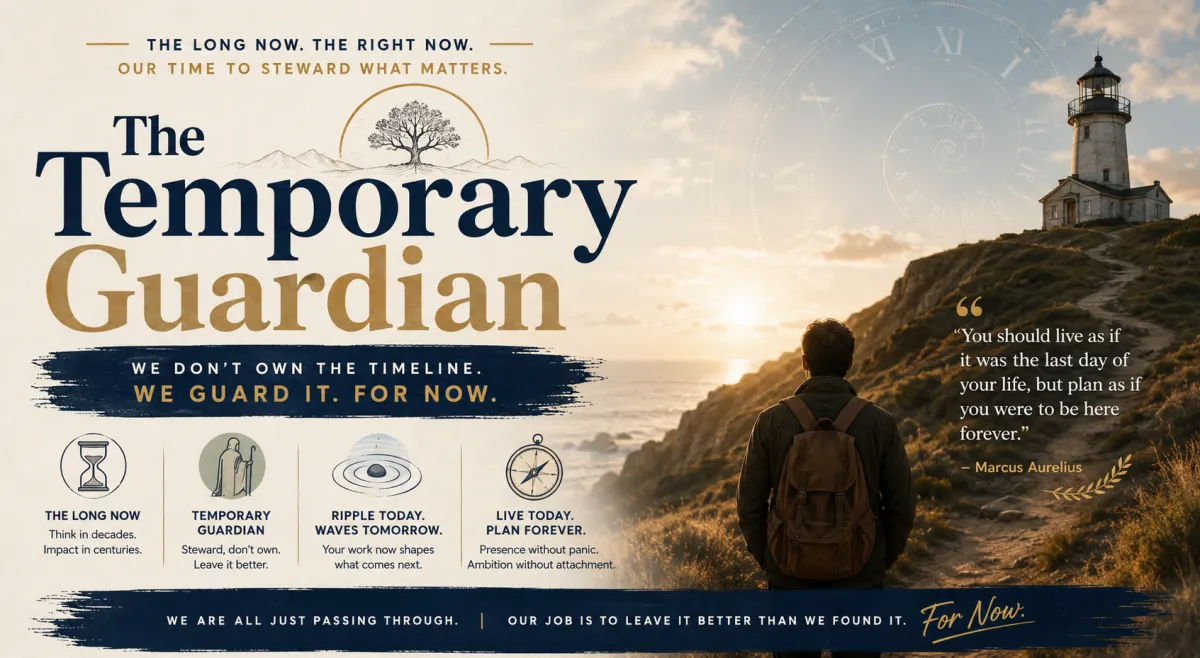
The Temporary Guardian
I've been sitting with two ideas lately that keep bumping into each other in the best possible way.
The first comes from Stewart Brand and Brian Eno - a concept called The Long Now. The idea is deceptively simple: we've become addicted to the short now. The next post, the next quarter, the next product launch. We've lost the ability to think in decades, let alone centuries. The Long Now is a practice - almost a discipline - of expanding your time horizon until the urgency of right now gets a little humbler.
Our world is so hurried. There’s just no room for slowing down anymore. No room for introspection. No room for stopping and smelling the goddamn roses. It’s all about scaling, speed, bigger, faster, more, more, more! If you’re not growing, man, then you’re dying and get with the fucking program already you hippie. You know, shit like that.
It’s exhausting frankly. The Long Now turns that on its head. It gets you out of the immediate Now, the Short Now, and gets you to focus on the Long Now. Not what’s going on today, next week, next month or even next year. But what is going on next decade, next century? What are you doing today whose ripples are causing waves in 2143? That’s humbling to think about.
The second idea came from an article I was reading in a recent edition of Robb Report about Brunello Cucinelli, the Italian fashion designer who built a billion-dollar company while apparently also just...being a good human. He quoted Marcus Aurelius, "You should live as if it was the last day of your life, but plan as if you were to be here forever." And then he said something that genuinely stopped me mid-page turn:
"It depends on whether you feel like a temporary guardian of things or an owner of things. I think that I'm just someone passing by. A temporary guardian in the timeline."
A temporary guardian in the timeline.
I don't know why that phrase hit me so hard, but it did. Maybe because it's the cleanest articulation I've ever read of something I've been fumbling toward for years.
I recently wrote an article about a couple of mushroom trips I had taken and I think this might be why it resonated so deeply. During those trips I felt so viscerally that we are simply passing through a vast, infinite time and space continuum that defies understanding. We are simply travelers in this Life. It would make sense that our concept of ownership is just an illusion and that we are merely guardians of what we “have” here.
The fact of the matter is, we don’t really own anything. We are just stewards over it. For now.
Here's my honest confession: I started Katuva with a very ownership mindset. I wanted to build something, scale it, prove something (to who?). There's nothing wrong with that per se - ambition is a good thing when channeled. But ownership thinking has a shadow side. It's possessive. It's anxious. It keeps one eye on protecting what you've built and another eye scanning for threats. It's exhausting in a way that's hard to name until you step back from it.
I had a buddy in middle school named Walter who would hover over his lunch tray while eating, ferociously protecting his food as if we were all going to attack him and steal his rubbery pizza and watery jello. He was so afraid of that, that he would wolf his food down and lived in constant fear of loss. That’s the ownership mindset to the extreme. (Plot twist Walter, no one wanted your food.)
The guardian mindset is different. If you're a guardian - not an owner - you're not building for yourself. You're tending something that was here before you and will continue after you. Your job is just to leave it better than you found it.
When I look at Katuva through that lens, the whole thing reframes. I'm not just running a virtual assistant staffing company. I'm a temporary steward of something that, done right, could genuinely change the professional trajectory of Filipino workers (and their families, economy, community, and so on) and reshape how American small businesses think about building their teams. That's not small. And importantly - it's not mine. Not really. I'm just the person in the timeline who gets to tend to it right now.
That's simultaneously more humbling and more motivating than pure ownership ever was. More importantly, the question that haunts me now that I have come to this realization is this:
How seriously are you taking this responsibilty?
The Long Now connects here in a way I find almost uncomfortable in its clarity.
Most of what I do on a daily basis is short-now thinking. What's the pipeline looking like? Did that lead convert? Can we hit our revenue goals this month? This year? These are real questions that deserve real attention. But they're not the whole picture, and if I'm not careful, they become the only picture.
Long Now thinking asks different questions. Not "how do I close this deal?" but "what kind of company does Katuva need to become over the next 20 years to still matter?" Not "how do I retain this client?" but "what does the relationship between US businesses and global talent look like in a generation, and are we building something that serves that future?" Not “is this the right VA for this client?” but also (and just as important) “is this the right client for this VA (and their family)?”
These questions don't have spreadsheet answers. But they're the ones that keep you from optimizing yourself into irrelevance. They’re the ones that help you fulfill the responsibility you agreed to carry when you started your company or your screenplay or your non-profit or your restaurant or whatever it is that you chose to be guardian over at this time in your life.
On a more personal level - and I'm being real with you here - I've spent a lot of my life living in the short now. Reactively. Putting out fires. Saying yes to things because they felt urgent rather than because they were important. Or saying yes (and I am literally cringing as I write this part) to things because they would make me more money. Measuring a good day by how productive it was rather than how intentional it was or how much joy it brought me.
I'm trying to change that. Slowly, imperfectly, but genuinely.
Part of that shift has been thinking about legacy - not in a morbid way and certainly not from a place of ego, but in the way Cucinelli means it. What am I stewarding? What do I want to hand off in better condition than when I received it? That question applies to Katuva, obviously. But it also applies to my marriage, my relationships, my health, the way I show up in my community, the person I'm becoming.
When I wake up every morning and look myself in the mirror, what will be the answer to the question I ask myself, “Are you a better person today than you were yesterday?”
The temporary guardian framing is actually deeply freeing, because it removes the ego from the equation. You're not trying to own a legacy. You're just trying to be a good steward of the present moment - which, if you zoom out far enough, is also the Long Now.
Marcus Aurelius had it right. Live like it's your last day. Plan like you'll be here forever.
Do those two things simultaneously and you get something rare: presence without panic, and ambition without attachment.
I'm not there yet. (Are any of us really?) But I'm pointing myself in that direction. And for a temporary guardian just passing through - I think that's enough.


