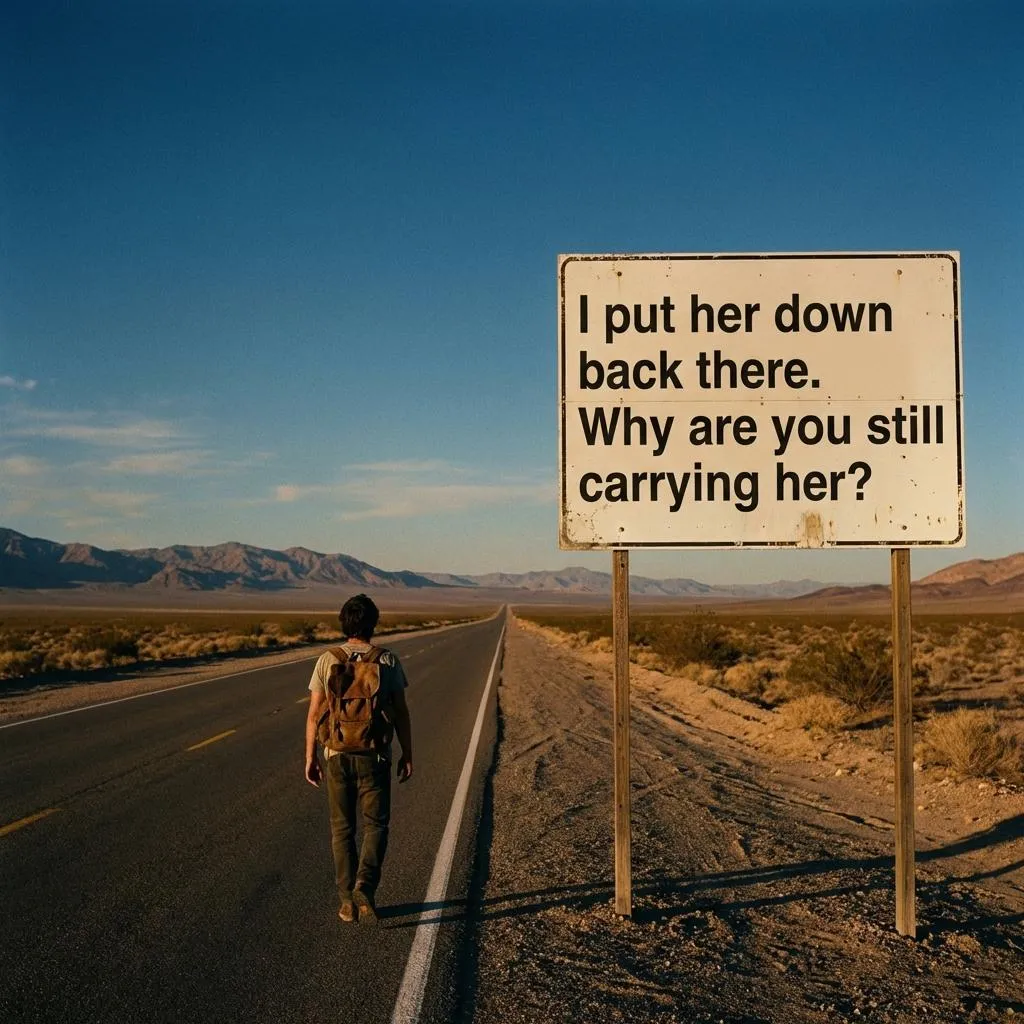
Are You Still Carrying Her?
Two monks walked along a muddy road after heavy rain.
They came to a river crossing where a woman stood, unable to pass without ruining her silk robes. The older monk, without hesitation, lifted her and carried her across. He set her down on the other side and continued walking.
The younger monk said nothing, but his mind churned. Hours passed. Finally, unable to contain himself, he spoke: "We have taken vows not to touch women. Why did you carry her?"
The older monk looked at him calmly.
"I put her down back there. Why are you still carrying her?"
That line has been following me around lately.
The Second Monk Lives in All of Us
Most of our suffering doesn't come from what happened.
It comes from what we refuse to put down.
The event lasted minutes. The woman crossed the river and walked away. Done.
But the resentment lasted hours. The mental replay lasted indefinitely. The younger monk turned a moment into a burden he carried for miles.
Here's the deeper truth: the first monk broke a rule. The second monk broke his peace.
One chose action in the moment. The other chose suffering long after the moment passed.
I've realized I do this constantly.
The Things I Carry
Sometimes I replay business decisions from years ago, turning them over in my mind like stones I can't put down.
That partnership I walked away from. That product launch that flopped. That conversation where I said the wrong thing.
The events are over. The outcomes are set. But I keep rehearsing them, as if replaying them enough times will somehow change what happened.
I carry weight struggles the same way. Not just the physical weight, but the guilt about it. The story I tell myself about discipline and control and what it means when I fall short.
I carry the pressure to be "the ambitious one." The person who's always pushing, always building, always three steps ahead.
And lately, I carry anxiety about AI and what it means for work, for value, for identity.
Sometimes I don't carry regret because I need it. I carry it because it makes me feel responsible.
Like the younger monk, I confuse the weight with virtue. I think carrying something proves I care. I think the burden itself is evidence of seriousness.
But that's not wisdom. That's just exhaustion dressed up as discipline.
Why We Don't Let Things Go
I've been thinking about why we do this. Why we pick things up and refuse to put them down, even when they hurt us.
Three reasons keep coming up:
We confuse guilt with growth.
We think replaying our mistakes keeps us sharp. We believe that if we stop feeling bad about something, we'll forget the lesson. So we rehearse the pain, over and over, as if suffering itself is the education.
But you can learn the lesson without carrying the shame. The event teaches you once. The replay just punishes you.
We confuse tension with productivity.
We think worrying equals preparing. We believe that if we're not anxious about something, we're not taking it seriously enough.
So we carry stress about things we can't control, as if the stress itself is doing something useful. As if being tense about the future somehow protects us from it.
Marcus Aurelius said it plainly: "You have power over your mind - not outside events. Realize this, and you will find strength."
We confuse identity with truth.
"I'm the disciplined one."
"I'm the driven one."
"I'm the one who doesn't let things slide."
These identities feel solid. They give us a sense of who we are. But sometimes they become prisons.
We carry behaviors and beliefs not because they serve us, but because we don't know who we'd be without them.
Sometimes we carry something not because it helps us, but because we don't know who we'd be without it.
The Modern Muddy Road
This pattern shows up everywhere in how we think about work right now.
We carry outdated definitions of productivity. We carry the belief that worth equals output. We carry anxiety about a future that hasn't happened yet.
I watch people panic about AI taking their jobs while simultaneously burning themselves out trying to prove their value through sheer volume of work.
We're carrying a version of ourselves built for a world that may no longer exist.
The rules we learned about career, about success, about what makes someone valuable - they were written for a different economy, a different pace, a different set of tools. A different life.
But we keep carrying them. We keep measuring ourselves against standards that may not even apply anymore.
The road has changed. The crossing is different now. But we're still arguing about rules from miles back.
What It Actually Means to "Put Her Down"
Letting go is not avoidance.
It's not laziness. It's not moral compromise. It's not apathy.
Letting go is recognizing the moment has passed.
It's refusing to rehearse pain as proof of seriousness. It's choosing peace over self-punishment.
The event happened. You were there. You felt it. You learned from it.
The lesson was learned. You changed your behavior. You made adjustments. You grew.
The moment ended. It's over. It's done. It's behind you.
The rest is optional.
You can keep carrying it if you want. You can keep replaying it, rehearsing it, turning it over in your mind.
But understand: you're choosing to. The weight is yours to put down.
A Simple Practice
Ask yourself: What am I still carrying?
Not metaphorically. Actually list it out. What old resentments, what past failures, what outdated identities are you hauling around?
Then ask: Is this helping me?
Not "Is this justified?" or "Do I have a right to feel this way?" Those questions keep you stuck in the past.
Ask: Is carrying this making my life better right now?
Finally: Would I choose to pick this up again today?
If it happened five years ago and you still feel it in your chest when you think about it, you're carrying it.
If you wouldn't choose to pick it up again today, maybe it's time to put it down.
Back to the Road
The road dries. The woman walks away. The moment disappears into memory.
Only one monk continues to suffer.
I think about this when I catch myself replaying old conversations, rehashing old decisions, carrying old versions of who I thought I had to be.
The older monk understood something the younger one didn't: peace isn't found in never breaking the rules. It's found in knowing when the moment is over. It’s found in living in the now.
I'm learning that discipline isn't about how much you can carry. Sometimes it's about what you're willing to put down.
The question isn't what you've carried.
The question is what you're still carrying.


