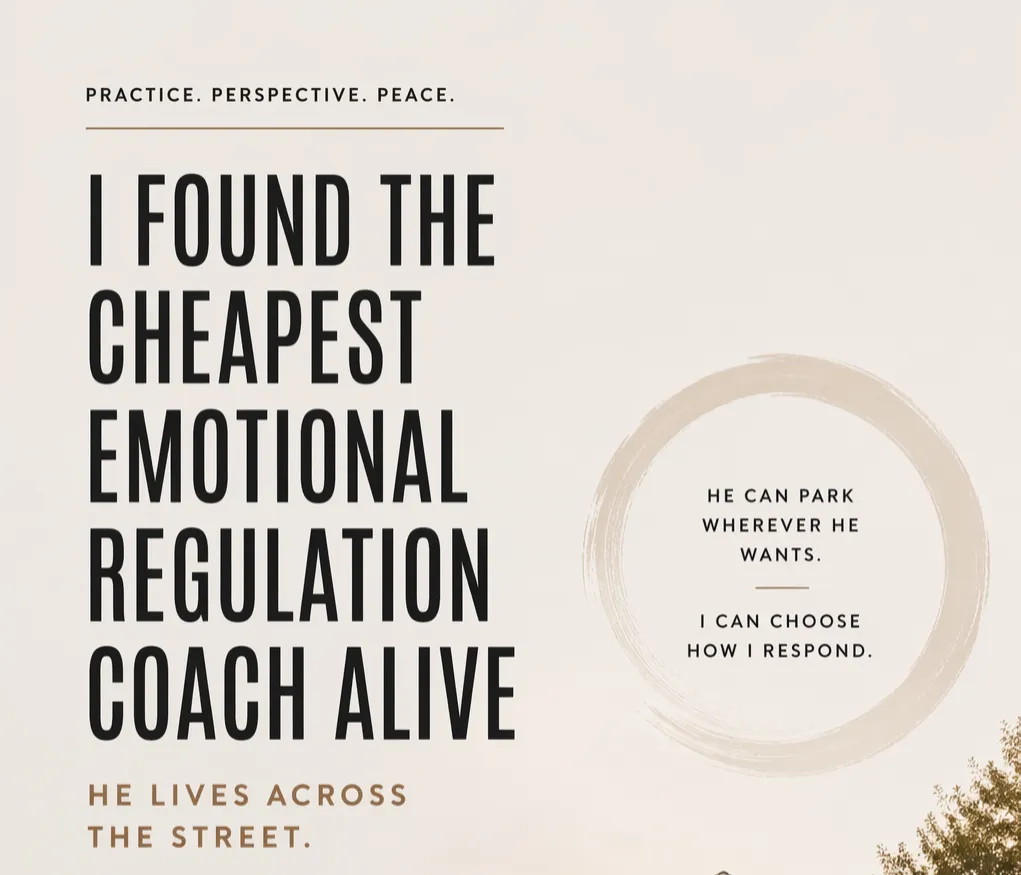
I Found the Cheapest Emotional Regulation Coach Alive - He Lives Across the Street
I want to tell you about this kid who has consumed more of my mental energy over the past year than he deserves. More than my businesses. More than my training. More, frankly, than some of my actual relationships.
He lives across the street. And he parks in front of my house.
The Skinny
Let me be clear about something before I go further: I am aware - painfully, embarrassingly aware - that this is a small problem. A first world problem if you will. There are people dealing with real hardship right now. Cancer diagnoses. Financial ruin. Actual crises. And here I am, a grown man, a business owner, a jiu jitsu practitioner, getting worked up because some guy parks his car in the wrong spot.
I know this…and yet...
Here's the situation. My neighbor who lives across the street from me and, who has a perfectly functional garage and a driveway (not to mention a giant cul-de-sac mere steps from his house), has made it a daily habit to park his vehicle directly in front of my house. Not occasionally. Not because he had guests over. Every. Single. Day. And not just during the day. It wasn't as if he would park there during the day and then move his vehicle into his garage at night. No, he would get home from work, park directly in front of my house, and then leave it there until the next morning when he'd leave for work.
Now, I want to be fair. Streets are public. Technically and legally speaking, anyone can park anywhere. I get it. But there's a social courtesy involved in living across from someone in a neighborhood, a social contract even. You don't park in front of people's homes. Not for extended periods of time anyway. This guy seems to have opted out of that implied contract entirely.
So I did what any reasonable adult would do. For the first month or so I just let it go. I figured, hey, they’re probably still getting settled, unloading boxes in their garage, whatever. After month two I was irritated enough that I dug into the CC&Rs, found the section that mentioned we weren’t supposed to park on the street and left a polite note on his windshield asking him to please park in his own garage or driveway, or even in front of his own house. (Yes, in hindsight, I probably should have talked to him in person, but honestly I just didn’t want any confrontation. I figured he would realize his error and stop parking there. I was wrong.)
His response: "I'll park wherever I want to." That wasn’t his response to my face. That was his metaphorical response because he just kept parking there in complete defiance of my note and my polite ask.
This was unacceptable.
I spent the next several days having imaginary arguments with this man in my head. I was articulate, devastating, and witty in all of them. He never had a chance.
Over time we waged this war of pettiness with one another. He would park as close to my driveway as he could without actually blocking it. One time I parked one of my cars behind him and another right in front of him, effectively blocking him in so he couldn’t get out. I thought it was hilarious. Kirsten, my wife, thought I was psychotic. The neighbor apparently agreed with her because he threw a tantrum and called the cops.
They came over and asked me politely to move my car. They also thought it was kind of funny, by the way, but they had to stay professional about it. I told them I would move my cars if he would stop parking in front of my house overnight.
Anyway, even though he stopped parking there overnight, nothing really changed. He still parks in front of my house whenever he gets the chance.
The Next Escalation (Because of Course There Was One)
But he just couldn't let this go. His bruised ego couldn't take it. A few weeks ago, things got better. By which I mean worse. Ever since he stopped parking in front of my house overnight I have pretty much left things alone.
But not him. He started doubling down. I'm not sure what changed - maybe he ate paint chips as a kid, maybe it was always in him, or maybe the universe just enjoys watching me grow as a person. But he began parking in front of my house with what I can only describe as intention.
The move that made me realize he was never going to let this go: trash day.
I put my garbage bins out front - standard practice, something humans have done since garbage bins were invented - and at some point during the day, I noticed his vehicle parked there. He had actually moved my bins out of his way to park in that spot.
He moved. My garbage cans.
I stood in my driveway for a long moment. I'm not going to tell you what I was thinking, but I will say it wasn't anything Marcus Aurelius or Jesus would've approved of.
The Part Where I Get Annoyed at Myself
Here's where it gets interesting - and honestly, a little uncomfortable to admit.
I couldn't let it go.
Not the incident. Not the low-grade daily irritation. Not the slow burn that greeted me every morning when I looked out the window and saw his car sitting there like a monument to his own self-satisfaction.
What bothered me more than the neighbor himself was my reaction to it. I'm not supposed to be this guy. I've done the work. I've read the books, I've been on the mat, I've been through actual hardship - real hardship, the kind that makes a parking dispute look laughable by comparison. I know better than to let something this trivial take up residence in my head.
And yet there it was. Every morning. Rent free.
The more I tried to not think about it, the more I thought about it. Which, if you've ever tried to not think about something, you know how that works. It's the mental equivalent of trying to not think of a pink elephant. The moment someone tells you not to think of a pink elephant, you realize you can't stop thinking about that goddamned pink elephant.
(You're thinking about a pink elephant right now. You're welcome.)
What I eventually realized is that I wasn't just irritated by the parking. I was irritated by the injustice of it. By the contempt. By the fact that I approached this man in good faith, as one adult to another, and he responded with the emotional sophistication of a twelve-year-old. Something in my wiring - probably the same something that made me a decent wrestler back in the day - doesn't know how to just absorb that and move on. It wants to fix it. To solve it. To win.
And the infuriating truth is: there's nothing to fix. There's no move to make. The board is set up in a way where the only winning move is not to play.
I hate that.
Enter Cato
If you've ever seen the original Pink Panther films, you know Inspector Clouseau. Bumbling French detective. Absolute disaster of a human being. Played magnificently by Peter Sellers.
And you may remember Cato.
Cato was Clouseau's manservant - loyal, efficient, and employed for one very specific additional duty: to attack Clouseau. Randomly. Without warning. At any moment of any day.
Clouseau paid him to do this.
The logic was simple: a detective must always be ready. Reflexes dull when they're never tested. Complacency is the enemy of competence. So Clouseau arranged for his own personal chaos - a lurking threat he'd commissioned himself - to keep his skills sharp. He'd come home to find Cato dropping from the ceiling. He'd open the refrigerator and take a flying kick to the face. He'd be mid-sentence with a beautiful woman and suddenly be in a headlock.
He never knew when it was coming. That was the point.
I thought about Cato one morning, standing in my driveway, staring at that prick’s car.
And something shifted.
What If He's My Cato?
Here's the reframe that actually helped me:
My neighbor is providing me with daily, unsolicited, completely free practice in emotional regulation.
Every morning, I get a rep. I feel the irritation rise - that familiar tightening, the flash of heat, the mental commentary that is absolutely not appropriate for a family blog - and then I have a choice. I can let it consume the next hour of my day. Or I can notice it, name it, and redirect.
That's the practice. That's literally what emotional regulation is. It's not the absence of feeling. It's the ability to feel it without being governed by it.
And this kid - this gloriously oblivious, garbage-can-moving monument to pettiness - is giving me reps I didn't ask for and definitely don't have to pay for.
Cato cost Clouseau a salary. My neighbor does this out of spite. Which, honestly, makes it better.
Jiu Jitsu Already Taught Me This
I've been training jiu jitsu for a while now, and one of the things it teaches you - one of the things it forces you to accept - is that you cannot control your opponent.
You can study their tendencies. You can prepare for their A-game. You can set traps and build systems and develop a game plan. But the moment you hit the mat, they're going to do something you didn't expect. Something that doesn't fit your plan. Something that puts you in a bad spot.
And in that moment, you have two options: panic and make it worse, or breathe, feel your way through it, and respond from a place of calm rather than reaction.
The people who get good at jiu jitsu are the ones who learn to be comfortable in uncomfortable positions. Not because the discomfort goes away - it doesn't - but because they stop fighting the feeling of being uncomfortable and start working the actual problem.
My neighbor is a Tuesday night, spazzy white belt sparring partner I didn't sign up for. He shows up every day. He's not going to change his game. He's not interested in a détente. He's just going to do what he does.
The only variable is me.
What the Practice Actually Looks Like
In case you're dealing with your own version of this - your own Cato, whatever form they take - here's what actually helps me:
Notice and name it. Don't try to skip to "I'm fine." Don't try to ignore it. Just be honest with yourself. I'm annoyed. This bothers me. There it is. Naming the feeling takes away some of its power. You're not suppressing it; you're acknowledging it without letting it drive.
Take the actions you can take, then close the file. I've looked into whether there's a local ordinance that applies. There may be options there (there aren’t; parking on public streets is completely legal, regardless of how I feel about it or whether the HOA has a rule about it). Fine - that's a card I can play if available and I choose to. But once I've noted the available moves, I close the file. I don't keep it open on my mental desktop consuming processing power all day.
Redefine what winning looks like. As long as my definition of winning involves him changing his behavior, I lose every day. The second I redefine winning as: he does what he does, I respond well, I go live my life - I'm winning every morning before he even pulls out of his driveway.
Let the image speak. I genuinely find it useful to picture what we're each doing on any given day. I'm building businesses, training, traveling, investing in relationships that matter to me. He's...moving trash cans. He's deliberately inconveniencing himself by parking in front of my house for a couple hours and then having to come back outside, get in his car, and move it into his garage...just to try and spite me. (That's kind of bananas when you stop to think about it.) The contrast does something helpful in my brain.
The Honest Ending
I won't tell you I've arrived somewhere enlightened. I still notice the car. I still feel a flicker of something when I see it. I'm not out here burning incense and sending him loving-kindness.
But it doesn't own my mornings anymore. And that's the actual goal - not to become someone who doesn't feel it, but to become someone who feels it and then gets on with their life anyway.
Every day he parks there, I get a rep. A small, free, involuntary rep in noticing a feeling and choosing my response. (The irony of this is, if he knew about this he’d probably stop parking there just to spite me.)
Some days I handle it better than others. That's fine. That's the practice. You don't go to the gym expecting a six-pack the next day. You show up, you do the work, you get incrementally better.
My neighbor is out there every day, unwittingly doing his part to make me a better human.
It would be a shame to let that go to waste.


