You're Treating Symptoms. Your Business Has a Disease.
Most business owners are excellent at spotting problems after they’ve happened. They're terrible at finding them beforehand.
That's a big difference.
Spotting a problem is easy. "I lost a client this week." "Revenue was down last quarter." "My best VA quit." These are visible, painful, and urgent. They demand your attention - and they get it.
Finding a problem is harder. It means asking why those things keep happening. It means digging past the panic and the firefighting to understand what's actually broken. And most business owners never get there - not because they're not smart, but because nobody taught them how to look.
That's where Systems Thinking comes in. Specifically, a framework called The Iceberg Model.
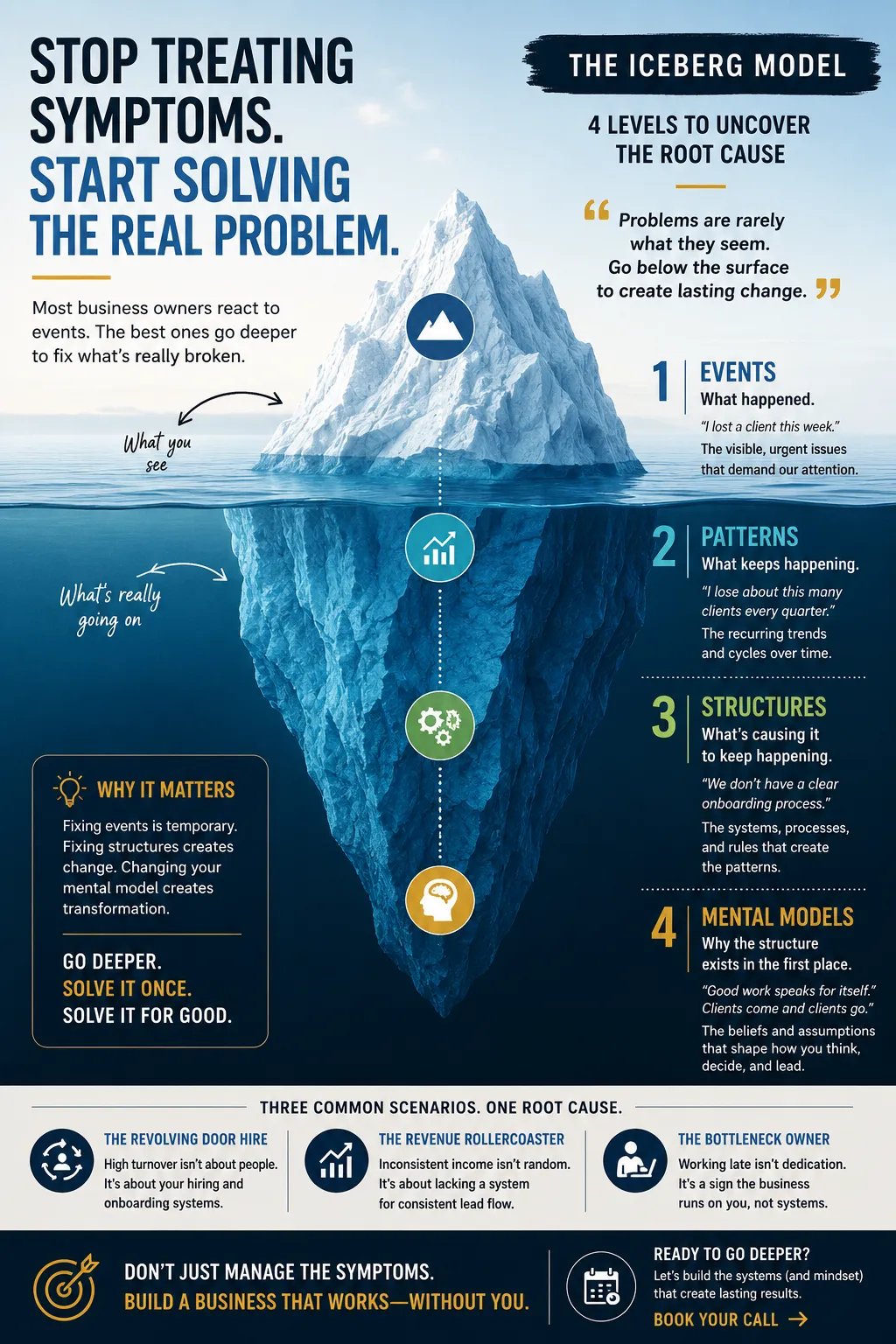
The Iceberg Model: A Quick Explanation
You know the old saying: 90% of an iceberg is below the surface. The Iceberg Model borrows that image and applies it to how we understand problems in business (and life).
It has four levels:
Events — What happened
Patterns — What keeps happening
Structures — What's causing it to keep happening
Mental Models — Why the structure exists in the first place
Most business owners live almost entirely at Level 1. Some push to Level 2. A rare few ever reach Levels 3 and 4.
And here's the brutal truth: if you're only working at Levels 1 and 2, you're not solving problems. You're managing symptoms.
Let's break each level down - and then apply it to scenarios you'll probably recognize.
Level 1: The Event
"I lost a client this week."
Events are the tip of the iceberg. They're the things you can see, measure, and react to. A customer complaint. A cancellation. A missed deadline. A bad month. An employee quit.
Events feel urgent because they are. But reacting to events is, by definition, reactive. You're always behind. You're always cleaning up a mess that's already happened.
The event is real. It matters. But it's just the beginning of the question - not the answer.
Level 2: The Pattern
"I've lost 5 clients this quarter. Actually, now that I think about it, I lose about this many clients every quarter."
This is where most business owners start to get uncomfortable. Because patterns require memory and honesty. You have to stop long enough to look backward - and be willing to see what you find.
Patterns reveal that events aren't isolated. They're recurring. The same client complaint. The same team breakdown. The same cash flow crunch at the end of every month.
Recognizing a pattern is progress. But it still doesn't tell you why. Most people stop here and conclude: "We have a client retention problem." Then they implement a retention tactic - a discount, a check-in email, a loyalty bonus - without ever understanding what's actually driving clients to leave.
That tactic might work. Once. Until the next quarter.
Level 3: The Structure
"We don't have a clear onboarding process. Clients come in with high expectations, and nobody sets the relationship up correctly from the start. By month two, they feel disconnected. By month three, they're gone."
Now we're getting somewhere.
Structures are the systems, processes, incentives, rules, and relationships that produce the patterns you've been experiencing. They're well below the waterline - you can't see them by watching what happens up top. You have to go looking for them.
The structure is rarely one single thing. It's usually a combination: a missing process here, a misaligned incentive there, a communication gap somewhere else. But when you find it, you'll often feel a mix of relief and embarrassment - because the answer was there the whole time, waiting to be discovered.
Structures are where real, lasting change happens. Fix the structure, and you fix the pattern - which means the events stop repeating.
Level 4: The Mental Model
"We've never really had an onboarding process because honestly...I figured good work speaks for itself. If the client isn't happy, that's kind of on them for having unrealistic expectations. Besides, that’s just how business works. Clients come and clients go."
This is the deepest and most uncomfortable level.
Mental models are the beliefs, assumptions, and worldviews that led you to build the structures you built (or fail to build them). They operate mostly in the background, shaping decisions you make without even realizing you're making them.
"That's just how this industry works." "Clients always have unrealistic expectations." "If you do great work, you don't need systems." "Sales is pushy and I don't want to be that guy." "Good people don't need to be managed."
These aren't just attitudes. They're architectures. They determine what you build, what you prioritize, and what you ignore - until the events and patterns make it impossible to ignore anymore.
Changing a mental model is hard. It requires humility, self-awareness, and usually some kind of pain. But it's also the only lever that creates permanent change. Fix the mental model, and every structure you build going forward improves. This is often the real disease in the business. Admitting it is one of the most difficult things you will be called on to do as a business owner.
Let's Apply It: Three Common Small Business Scenarios
Scenario 1: The Revolving Door Hire
Event: You hired an employee two months ago. She just quit.
Pattern: You've gone through four employees in the last year. Every time, you think you found the right one. Every time, it doesn't work out.
Structure: You don't have a documented onboarding process. The employee joins with no SOPs, no clear KPIs, no feedback loop, and no defined path to mastery. She's left to figure out how you think by trial and error - mostly error. After weeks of feeling confused and undervalued, she finds another opportunity.
Mental Model: "I shouldn't have to document everything. A good employee should be able to figure it out. I need someone who's a self-starter." (Translation: I want someone to read my mind and not require anything from me.)
The Fix: The event won't stop until the mental model shifts from "a good hire solves the problem" to "a good system makes a good hire possible."
Scenario 2: The Revenue Rollercoaster
Event: You had a great month last month. This month is brutal. You're stressed.
Pattern: Revenue spikes and crashes on roughly a 90-day cycle. When you're busy delivering, you stop selling. When projects end, there's nothing in the pipeline. Panic. Repeat.
Structure: You have no consistent lead generation activity. No content rhythm. No outreach cadence. No referral system. Sales happens when you remember to do it - which is only when you're scared.
Mental Model: "Sales is uncomfortable, and I'm better at doing the work than selling it. If I just deliver excellent results, clients will (read: should) refer people and the business will grow organically."
The Fix: The cycle won't break until you accept that pipeline maintenance is a non-negotiable weekly discipline, not an emergency response - and that belief has to come before the system will stick.
Scenario 3: The Bottleneck Owner
Event: It's 10pm on a Friday and you're still working. Again.
Pattern: You work nights and weekends constantly. Your team is idle by 5pm waiting for your approval on their work. Nothing gets done without your direct involvement. You've tried to delegate, but things always fall apart.
Structure: You don't have SOPs. You haven't defined quality standards. You insist on approving everything before it goes out. You've never trained anyone to make decisions because you've never documented what a good decision looks like.
Mental Model: "Nobody does it as well as I do. It's faster for me to just do it myself. If I want it done right, I have to be involved."
The Fix: The late nights won't end until the belief shifts from "I am the system" to "my job is to build the system." And that shift usually requires hitting a wall - a health scare, a missed family moment, a near-breakdown - that makes the old belief too expensive to keep holding.
How to Use This in Your Own Business
You don't need a whiteboard or a consultant. You need a committed hour and a few honest questions.
Step 1: Name the event. Pick one recurring problem. Something that keeps coming up. A complaint, a breakdown, a result you're not happy with. Write it down.
Example: We keep missing project deadlines.
Step 2: Find the pattern. How long has this been happening? How often? Under what conditions? What does it look like across time?
Example: We miss deadlines about 60% of the time, usually when we take on new clients and when my lead employee is managing more than three projects.
Step 3: Map the structure. What systems (or lack thereof) are producing this pattern? Look at your processes, your tools, your team capacity, your communication, your incentives. What's missing? What's misaligned?
Example: We don't have a project intake process. New projects get added without checking current bandwidth. Nobody tracks capacity in real time. Deadlines get set based on what the client wants, not what we can actually deliver.
Step 4: Surface the mental model. Why does that structure exist? What did you believe - about yourself, your team, your clients, your industry - that led you to build it this way or not build it at all?
Example: I believed that being flexible and accommodating was a competitive advantage. I never wanted to tell a client we couldn't take something on. I thought saying yes was what kept them happy.
Step 5: Challenge the belief. Is that mental model actually true? Is it serving you? What would have to be true for you to believe something different and what would change if you did?
Example: What if accommodating every request without a system is actually what's destroying client trust? What if capacity planning is how you protect the client relationship, not damage it?
The Bottom Line
Events are what your business shows you. Patterns are what your business is telling you. Structures are what your business is built on. Mental models are why it was built that way.
If you've been frustrated that nothing seems to stick - that you implement a new tactic and it works for a month and then you're back where you started - this is probably why. You've been solving at Level 1 and Level 2 in a Level 3 and Level 4 problem (mostly 4).
The iceberg doesn't care how smart you are or how hard you work. It just sits there, mostly invisible, doing what icebergs do.
The question is whether you're willing to go below the surface.
If this resonated, it's probably because you already know there's more going on beneath the events you're managing. The first step is always the same: stop reacting long enough to start asking why. If you’d like to explore how we can help by helping you place a highly trained virtual assistant versed in these concepts book a call with me personally here: Book Your Call


