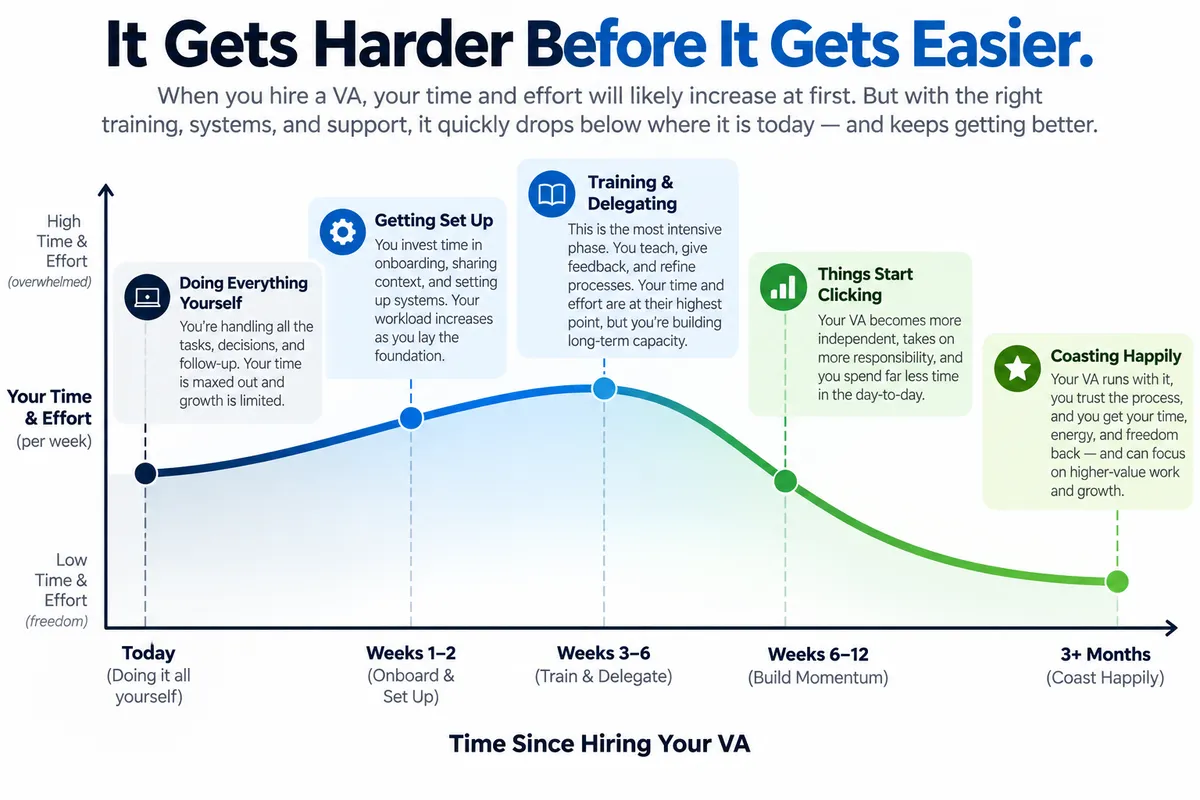
The Delegation Investment Curve
The Short Term Cost of Long Term Freedom
Here’s a question I get from prospective clients all the time:
When I hire a new virtual assistant, will I have to train them?
I’ll admit, this question used to drive me nuts. “Of course you are going to have to train them!” I would rage in my head, “Do you think they are going to come to work for you on the first day with the ability to read your mind and know exactly what you want them to do?!”
I almost gave myself an ulcer over this.
What I came to understand about this question, though, is what people are really saying is, “I am already so overwhelmed with my day-to-day work, I don’t know how I am going to add this to my plate as well. I’m hiring someone to make my life easier. Please don’t tell me that hiring this person is going to create even more work for me.”
And that’s fair. I totally get that. Being overwhelmed is understandable. Being unwilling to participate in the solution, however, is not.
Here's the reality: For a little while, your workload might actually increase.
But consider the alternative.
Another five, ten, or twenty years of doing everything yourself. Drowning in busywork. Wearing all the hats. Slowly burning out. Stressed to the gills.
Is spending a few extra hours each week training someone for the next month or two really worse than that?
It sounds kind of silly when you put it that way.
Here’s the uncomfortable truth: No one can take responsibility for your business until you’ve taught them what responsibility looks like in your business.
When you hire Katuva to help you find a virtual assistant, our job is to match you with someone who has the skills, capabilities, and experience needed to succeed in the role.
But even the most talented VA won't arrive knowing your business, your customers, your preferences, or your way of doing things.
That's knowledge only you can provide.
And the sooner you're willing to share it, the sooner your VA can start taking meaningful responsibilities off your plate.
Introducing the Delegation Investment Curve
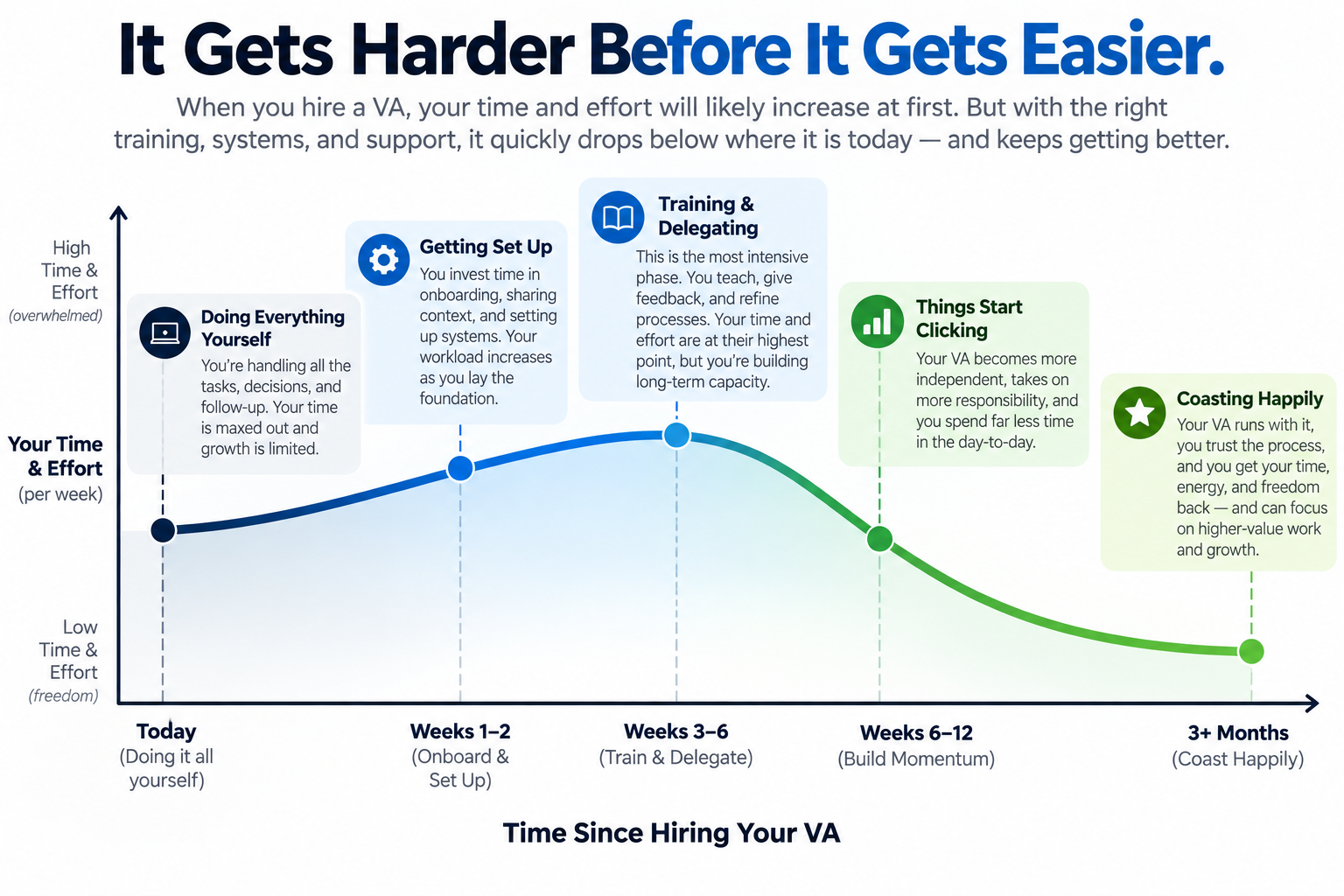
We call this The Delegation Investment Curve. As you can see, on the Y axis is Your Time & Effort and on the X axis is Time Since Hiring Your VA. In the beginning your life already kind of sucks because you are doing everything yourself. During the Getting Set Up and Training & Delegating phases life starts to suck some more as you and your VA are trying to find your footing and build a relationship with one another.
But, then Things Start Clicking and life starts looking brighter. Before long you are Coasting Happily and you are sending me fine wine (I like Bordeaux) and expensive cigars (anything from Nicaragua) to say thank you for saving your life.
Still not convinced? Let’s do a little math. (I know, I know, math sucks too. But stick with me for just a second.)
Imagine you spend an extra five hours per week training your VA for six weeks. That’s 30 total hours of your time invested.
Let’s further assume that at the end of those six weeks your VA can now independently handle 10 hours of work per week.
Check out the calculator below. By investing just 30 hours upfront, you could recover 460 hours during the remainder of your first year. Subtract your initial training investment, and that's a net gain of 430 hours!
And once your VA is fully trained? You're potentially recovering more than 500 hours every year.
Go ahead, play with the calculator a bit and see how much time you could be saving just by making a relatively small upfront investment. As you'll see, the payoff can be enormous!
What Delegation Actually Requires
Here's something I wish more business owners understood: Delegation isn't just handing someone a task and expecting them to figure it out. It's transferring responsibility from yourself to someone else.
And that doesn't happen by magic.
Think about it. You've spent years learning how to run your business. You know your customers, your systems, your preferences, and all the little things that make everything work. Most of that knowledge is probably stored somewhere between your ears.
Now you're hiring someone and expecting them to take over responsibilities you've spent years mastering.
How exactly are they supposed to do that if you aren't willing to teach them?
Fortunately, good delegation isn't rocket science. It really comes down to four things.
1. Clear Expectations: Define What Success Looks Like
Imagine telling your new VA to "manage my inbox."
Great. What does that mean?
Should they respond to emails? Which ones? How quickly? What should they do when someone asks a question they can't answer? What decisions can they make without asking you?
You might know exactly what you mean by "manage my inbox," but your VA doesn't.
And when they inevitably do something differently than you expected, whose fault is that?
If you want someone to deliver the results you're looking for, you have to tell them what those results look like.
The clearer you are upfront, the less time you'll spend correcting misunderstandings later.
2. Training: Make the Investment Upfront
Here's where we come back to that question everyone loves asking me.
"But I don't have time to train someone!"
I get it. You're busy. That's why you're hiring help in the first place. And I know what you’re thinking: It’s faster if I just do it myself.
Yeah. Once. But you’re doing it every day.
Consider this: If you spend 30 minutes every day on a task, that's roughly 130 hours per year.
What if you could spend three or four hours teaching someone else to do it and never have to do that task yourself again?
Sounds like a pretty good trade to me.
And training doesn't have to mean writing a 50-page instruction manual. Record your screen while you perform a task. Explain what you're doing and why. Let your VA turn that recording into a step-by-step process.
Congratulations. You've just created a system that someone else can operate.
You're not wasting time training your VA. You're buying back your future time.
3. Feedback: Expect Progress, Not Perfection
Your VA is going to make mistakes.
You know who else makes mistakes? You do. So do I. We all do.
(True story: I had a VA pay one of our contractors twice and we were never able to get that money back. Dude ghosted us and I never heard from him again. That was a big mistake. So, I put guardrails in place so it didn’t happen again. And that VA, she quadruple checks everything now!)
Yet some business owners expect a new employee to get everything right the first time.
And when they don't? They throw their hands up, declare that nobody can do anything right, fire the employee, and take the task back.
Congratulations! You've just guaranteed you'll be doing that task forever.
Instead, figure out what went wrong. Was something unclear? Did you forget to explain an important detail? Does the process need improvement? Is there a system missing?
Correct the problem, provide feedback, and let your VA try again.
And when they do something well, tell them that too.
The goal isn't perfection on day one. It's steady improvement until they no longer need you looking over their shoulder.
4. Increasing Autonomy: Learn to Let Go
This is where delegation starts to pay off.
In the beginning, you show your VA how to do something.
Next, they do it while you guide them.
Then they do it independently while you check the results.
Eventually, they own the responsibility entirely.
Notice what's happening? With each step, they're doing more and you're doing less.
That's the whole point!
But there's a catch. You have to actually let go.
If you're still approving every email, checking every detail, and making every little decision, you haven't delegated responsibility. You've just hired someone to help you stay busy.
And here's another thing: Your VA doesn't have to do everything exactly the way you would.
If they're getting the results you want, who cares if they take a slightly different route to get there?
They might even find a better way.
The objective isn't to create a clone of yourself. It's to develop someone who can get the job done without you.
The Payoff: A Business That Does More, But Requires Less of You
That's it. Clear expectations. Training. Feedback. Increasing autonomy.
None of this is complicated. But it does require something from you: a willingness to invest a little more time and effort today to recover a whole lot more tomorrow.
And that's what the Delegation Investment Curve is all about. It's not just about saving time. It's about increasing your capacity to grow your business without requiring more of yourself.
If you aren't willing to invest the time to teach someone else to do the work, you're choosing to keep doing that work yourself.
It's really that simple.
I Know This Works Because I’ve Done It
People sometimes don’t believe me when I tell them I only work 12-15 hours per week at Katuva, but it’s true. I have a team of (currently) seven virtual assistants of my own that pretty much run every facet of my business except for sales.
But it wasn't always that way.
I didn't hire seven VAs one day, hand them the keys to Katuva, and disappear to the golf course.
I started by teaching someone to handle a few responsibilities. Then a few more. I documented processes, answered questions, corrected mistakes, and gradually handed over more authority.
Then I did it again. And again.
Over the years, those small investments compounded into something extraordinary: a business that can operate almost entirely without me.
And here's the important part: You don't need seven VAs or years of work to start experiencing the benefits. You just need to be willing to make that first investment.
So, now it’s your turn. At Katuva, we can help you find the right person. We can help you identify what to delegate, develop processes, and create a plan for transferring responsibilities.
But there's one thing we cannot do for you.
We cannot care more about the success of your business than you do.
If you're looking for a magic button that makes all your work disappear overnight, Katuva probably isn't for you. (No VA company is, regardless of what they promise you.)
But if you're ready to roll up your sleeves, make a relatively small investment of your time, and start building a business that doesn't depend on you for everything, we should talk.
Let's build something that gives you your life back.


